

24 May How to Improve Indoor Cycling Comfort for Long Training Rides
Long training rides on an indoor bike are a serious commitment. They demand physical endurance, mental focus, and a training environment that supports both. Many cyclists set up a stationary bike in a spare room, clip in, and start pedalling without giving much thought to what surrounds them. That approach works fine for short sessions. However, once you push beyond 60 minutes, every detail of your environment begins to matter.
Discomfort during long indoor rides rarely comes from effort alone. It comes from heat buildup, poor airflow, an ill-fitting setup, and a space that was never designed with sustained training in mind. The great news is that all of these problems are fixable. Small, deliberate changes to your room, your equipment, and your habits can transform a difficult indoor session into a genuinely enjoyable one.
This article walks you through every key area of indoor cycling comfort so your longest training rides feel as manageable as possible.
Why Long Indoor Rides Feel Harder Than Outdoor Ones
Before diving into solutions, it helps to understand the problem. Riding indoors is physically different from riding outside, and not just because the scenery does not change.
When you ride outdoors, wind moves across your body continuously. That airflow does two important things. It removes heat from your skin and accelerates the evaporation of sweat. Both effects keep your core temperature stable even during intense efforts.
Indoors, neither of those things happens naturally. You are stationary, the air around you is still, and your body produces heat faster than it can escape. As a session progresses, the room gets warmer, humidity rises, and your cardiovascular system works harder just to manage your temperature. That extra effort has a real cost. Studies on exercise in heat consistently show that perceived effort increases and power output drops as core temperature climbs.
Additionally, the mental load of riding in a warm, poorly ventilated room increases fatigue faster than the physical effort alone. Therefore, improving your training environment is not just about comfort. It directly affects your performance and how much you are able to achieve in each session.
Choosing the Right Room for Your Indoor Bike
Your choice of training room sets the ceiling on how comfortable your sessions can be. Not every room is equally suited for sustained indoor cycling.
Look for Natural Coolness First
Rooms on the ground floor or in a basement are naturally cooler than upper-floor spaces because heat rises. They are also less exposed to direct sunlight, which is one of the biggest sources of ambient heat during the day. If your home has a basement, it is worth considering as your primary training space even if it requires some setup work.
Rooms on the north or east side of a house receive far less afternoon sun than south or west-facing rooms. If your only option is an upper-floor room, choosing the shadiest side of the house makes a meaningful difference, especially in summer.
Consider Ceiling Height and Room Volume
A larger room holds more air, which means it takes longer to heat up during a session. High ceilings are particularly helpful because they give warm air somewhere to rise without immediately affecting the air at rider level. If you have a choice between a compact room and a larger one, the larger space will almost always be more comfortable for long rides.
Check for Existing Ventilation
Before settling on a room, check whether it has windows that open on at least two walls, a ceiling vent, or access to a hallway where a door can create a cross-draft. Good cycling room ventilation starts with the structure of the space itself. You can add fans and coolers later, but a room with natural ventilation options will always outperform a sealed box regardless of how much equipment you add.
Building Effective Airflow in Your Training Space
Once you have chosen your room, the next step is engineering the airflow within it. This is where most cyclists can make the biggest gains in comfort with relatively little expense.
Create a Cross-Ventilation System
Cross-ventilation is the principle of moving air through a space by opening inlets and outlets on opposite sides. Open a window near your bike and another on the far side of the room or in an adjacent hallway. Air enters through one opening, flows across the space, and exits through the other. Even on a still day, this creates a gentle but consistent breeze that significantly improves home workout airflow.
However, cross-ventilation only works when the outside air is cooler than the indoor air. On hot summer days, you may need to keep windows closed and rely on mechanical cooling instead. Early morning and late evening are the best times to use natural ventilation, when outside temperatures are lower than the air inside your training space.
Position Fans for Direct Airflow
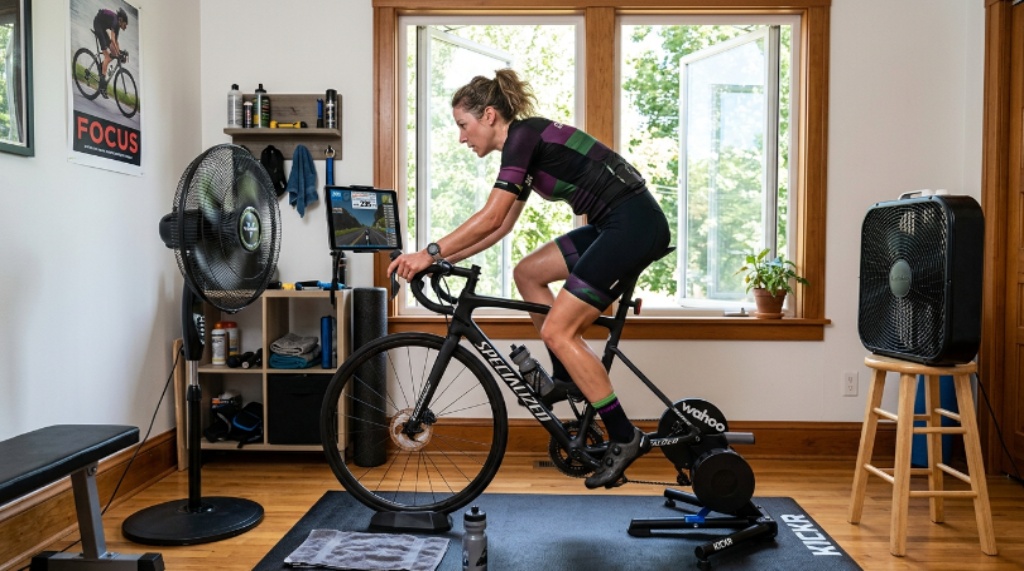
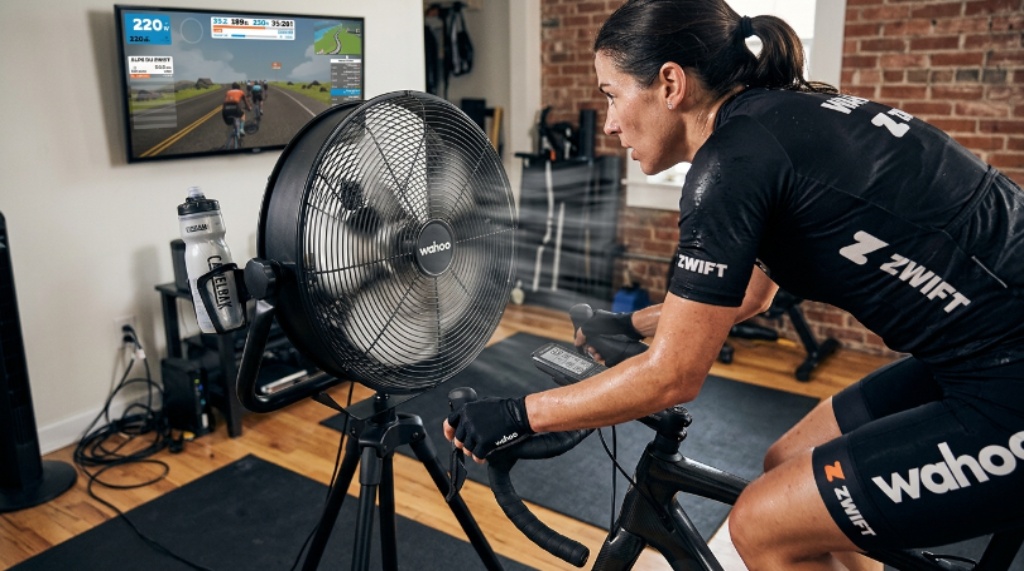
A fan is essential for any indoor training setup, but placement determines how effective it is. Position your primary fan directly in front of your bike at chest height, angled slightly upward toward your face and torso. This targets the areas of your body that generate and retain the most heat.
A fan pointed at your legs or positioned behind you provides far less benefit. The goal is to move air across your chest, shoulders, and head, where the highest concentration of sweat glands sits and where evaporative cooling is most effective.
For long sessions, a high-velocity floor fan is worth the investment over a standard desk model. The volume of air it moves is substantially greater, and that difference becomes very apparent during the second hour of a hard ride.
Add a Second Fan for Whole-Room Control
A second fan changes the dynamics of the entire room. Place it near a doorway or window pointing inward to pull cooler air from outside or from a hallway into the training space. Combined with your primary fan, this creates a continuous circuit of air movement that prevents the room from gradually heating up as your session progresses.
Additionally, a ceiling fan running on its highest setting helps displace the warm air that rises and collects near the ceiling. This keeps the ambient temperature lower at rider level throughout your session.
Optimising Your Bike Setup for Extended Comfort
A well-ventilated room helps enormously, but it cannot compensate for a bike that fits poorly or causes pain over time. Long rides amplify every small fit issue into a significant discomfort.
Get Your Saddle Height Right
Saddle height is the single most important fit variable on any bike. A saddle that is too low causes knee pain and reduces pedalling efficiency. One that is too high creates hip rocking and discomfort in the lower back and hamstrings. Your knee should have a slight bend of around 25 to 35 degrees at the bottom of the pedal stroke.
If you have been riding with saddle height set by guesswork, take 10 minutes to measure and adjust it properly. The improvement in comfort during long rides is immediate and significant.
Check Your Handlebar Position
Handlebars that are too low place excessive weight on your hands, wrists, and lower back. Over a long ride, this leads to numbness in the hands and aching through the lumbar spine. Raising the handlebars slightly reduces the reach and allows you to hold a more relaxed, upright position without compromising your pedalling mechanics.
Many indoor bikes offer both height and reach adjustment. Experiment with small changes and give yourself a full ride to assess the difference before making further adjustments.
Invest in a Quality Chamois
Saddle soreness is one of the most common reasons cyclists cut indoor rides short. The chamois in your bib shorts is the primary protection between you and the saddle, and not all chamois are created equal. A well-designed chamois with appropriate density and shape for your body distributes pressure evenly and reduces friction over long periods.
For indoor rides, choose a chamois that breathes well. Indoor heat and humidity accelerate skin irritation, so a breathable, moisture-wicking chamois matters even more than it does outside. Additionally, chamois cream applied before a long session reduces friction significantly and is one of the simplest comfort improvements available.
Managing Noise and Mental Fatigue on Long Rides
Physical comfort is only part of the equation on long indoor sessions. Mental fatigue sets in for most cyclists long before their legs give out, and the training environment plays a significant role in how quickly that happens.
Noise is a commonly overlooked factor. A loud trainer, a rattling fan, or sound bouncing off bare walls creates a fatiguing acoustic environment. Rubber mat flooring under your bike absorbs trainer vibration and reduces noise transfer to the rest of the house. Soft furnishings like a rug, curtains, or foam panels absorb sound reflections and create a calmer atmosphere that is easier to sustain mentally for long periods.
Entertainment also matters. Having a reliable screen, a well-planned playlist, or a structured training programme to follow gives your mind something to engage with. Cyclists who ride with a purpose, a structured interval plan or a virtual route, consistently report longer and more satisfying indoor sessions than those who simply ride without a plan.
Hydration and Nutrition for Extended Indoor Sessions
Long rides require sustained fuel and fluid intake, and the demands are greater indoors than most people expect. Without the cooling effect of outdoor airflow, you sweat more and lose fluid faster for the same intensity of effort.
Drink before you feel thirsty. A schedule of 150 to 250 millilitres every 15 minutes keeps your fluid intake consistent and prevents the gradual dehydration that impairs both performance and temperature regulation. For rides exceeding 75 minutes, add electrolytes to your water to replace sodium and potassium lost through sweat.
Nutrition timing matters for rides over 90 minutes. Consuming 30 to 60 grams of carbohydrate per hour from the 45-minute mark helps maintain power output and delays the mental fatigue that comes from depleted glycogen stores. Easy-to-eat options like energy gels, chews, or bananas work well on the bike without requiring you to stop.
Conclusion
Long indoor training rides become dramatically more manageable when you approach your setup with the same care you give your training plan. Start with your room. Choose a naturally cool space with good structural ventilation and set up your cycling room ventilation with fans positioned for direct airflow across your body. Optimize your bike fit to prevent the discomfort that compounds over time, and invest in quality kit and chamois to protect against heat and friction.
Manage your home workout airflow actively throughout the session, hydrate on a consistent schedule, and give your mind the engagement it needs to stay focused for the full duration. Every element works together. When your environment supports your effort, long rides stop feeling like an endurance test against the room and become a genuine training opportunity that leaves you fitter, stronger, and ready to go again.
Frequently Asked Questions
How many fans do I need for a comfortable long indoor cycling session?
Two fans are the recommended minimum for sessions lasting over 60 minutes. One positioned directly in front of you at chest height and one near a doorway or window to draw in cooler air. A ceiling fan adds a useful third layer of whole-room air circulation.
What is the ideal room temperature for long indoor training rides?
Most cyclists perform best between 16 and 20 degrees Celsius. Temperatures above 24 degrees significantly increase perceived effort and reduce power output. Pre-cool your room with air conditioning or by opening windows at least 20 to 30 minutes before your session begins.
How do I stop my hands going numb on long indoor rides?
Handlebar numbness is usually caused by too much weight on your hands from an overly aggressive riding position. Raise your handlebars slightly and check that your elbows are not locked out straight. Wearing padded cycling gloves also helps distribute pressure more evenly across the palm.
Is it normal to sweat significantly more indoors than outdoors?
Yes, and it is well documented. Without outdoor airflow to assist evaporation, your body produces more sweat to achieve the same cooling effect. Indoor cyclists can lose 50 to 100 percent more fluid per hour than outdoor riders at the same intensity. Adjusting your hydration strategy accordingly is essential.
How can I reduce trainer noise without soundproofing my whole room?
A thick rubber mat under your bike absorbs most vibration before it transfers to the floor. Placing a folded yoga mat or additional rubber layer under the front wheel block also helps. Beyond that, a trainer with a direct drive mechanism is substantially quieter than one that uses a roller against the rear tyre.
Sorry, the comment form is closed at this time.