

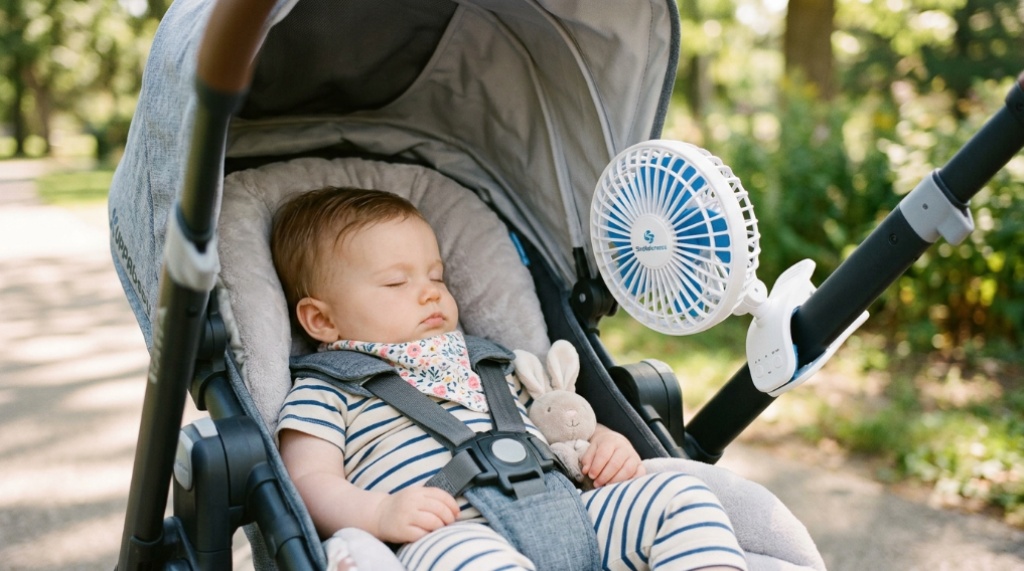
24 Sep How to Keep Your Baby Cool and Comfortable During Summer Stroller Walks
A baby who is flushed, sweaty, and fussy halfway through a summer walk is not just uncomfortable — overheating is a genuine safety concern, since infants regulate body temperature less efficiently than adults. Portable clip-on fans have become one of the most practical fixes for stroller heat, and a hands-on Gaiatop mini stroller fan review is a useful starting point if you are weighing that specific model. But a fan alone does not guarantee a cool baby. This guide covers what actually keeps an infant comfortable on hot walks, what a mini fan can and cannot do, and how to avoid the mistakes that turn a quick outing into a heat problem.
Quick Answer
Keep a baby cool during summer stroller walks by walking in early morning or evening, using a breathable stroller canopy, dressing the baby in light single-layer clothing, and adding airflow with a small clip-on fan. Check the baby every 10–15 minutes, offer fluids if age-appropriate, and stay home when the heat index is high. No single gear item replaces timing and vigilance.
Key Takeaways
- Timing matters more than any product — walks before roughly 10 a.m. or after the peak afternoon heat avoid the worst conditions entirely.
- A clip-on mini fan improves airflow inside the stroller but does not lower air temperature; it works best alongside shade and proper clothing.
- Stroller canopies can trap heat if fully closed — ventilation matters as much as shade.
- Overheating signs in babies include flushed skin, sweating, rapid breathing, and unusual fussiness or lethargy. Any of these means ending the walk and cooling the baby down.
- The fan’s runtime, clip stability, and safety cage matter more for real-world stroller use than fancy extra features.
Why Babies Overheat More Easily Than Adults
Infants have a higher surface-area-to-body-mass ratio than adults, which means they absorb heat from their surroundings faster and have less capacity to dissipate it. Their sweat glands are also less developed, so sweating — the body’s main cooling mechanism — is less effective in the first months of life.
The practical consequence is that conditions an adult would call “warm but fine” can push a baby toward overheating. A stroller adds to the problem: it is a confined space with limited airflow, and the seat padding and canopy can hold warmth around the baby’s back and head. This is why pediatric guidance generally recommends keeping babies out of direct sun and avoiding prolonged exposure to high heat, and why vigilance matters more than any single gadget, To ensure your toddler stays rested and properly supported during hot weather travel and naps, make sure to pair your stroller setup with the best pillow for your child.
The Role of a Mini Stroller Fan — and Its Limits
A clip-on fan moves air across the baby’s skin. That moving air helps evaporate moisture and improves heat exchange, which feels cooler even when the air temperature itself is unchanged. It does not refrigerate the stroller, and it cannot compensate for walking in the worst heat of the day.
In practice, a fan is most useful in three situations:
- Walks in warm but not extreme conditions, where airflow makes the difference between “sticky” and “comfortable.”
- Stroller naps, where the baby is stationary and heat builds up in the seat.
- Covered strollers or car-seat-to-stroller transitions, where the seating area gets less natural breeze.
Where a fan fails is in high heat with high humidity, when the air itself is hot and the fan just circulates warm air. In those conditions, the answer is to stay indoors, not to crank the fan higher.
What Actually Matters When Choosing a Mini Fan
Most mini stroller fans look similar in listings, but a few features separate the genuinely useful ones from the frustrating ones:
- Battery runtime: A stroller walk can easily run 45–90 minutes, plus naptime. A fan that dies in 30 minutes is not useful for a real outing.
- Clip or clamp strength: Stroller frames, canopies, and handlebars vary in thickness. A weak clip slides or pops off on uneven pavement.
- Blade safety: For anything within a baby’s reach, a covered or bladeless design is important — small fingers find gaps.
- Noise level: A loud fan can keep a baby from settling for a nap, defeating part of the purpose.
- Adjustability: The ability to angle airflow toward the baby’s torso rather than directly at the face makes the fan more effective and more comfortable.
Where the Gaiatop Mini Fan Fits
Fans like the Gaiatop mini clip-on model are typically designed around flexible tripod legs that wrap around stroller frames, with rechargeable batteries and multiple speed settings. That form factor is well suited to strollers because it can be repositioned between the canopy bar, the handle, or the side rail as the baby grows. Models in this category generally aim for a balance of portability and a runtime long enough for a normal walk.
As with any fan in this class, the realistic expectation is improved airflow, not air conditioning. Positioned to move air across the baby’s chest and legs with the canopy partly open for ventilation, it can meaningfully change how comfortable a warm-weather walk feels. Positioned blowing directly into the baby’s face, or used with a fully closed canopy, it accomplishes much less.
Stroller Setup: Shade, Airflow, and the Canopy Trap
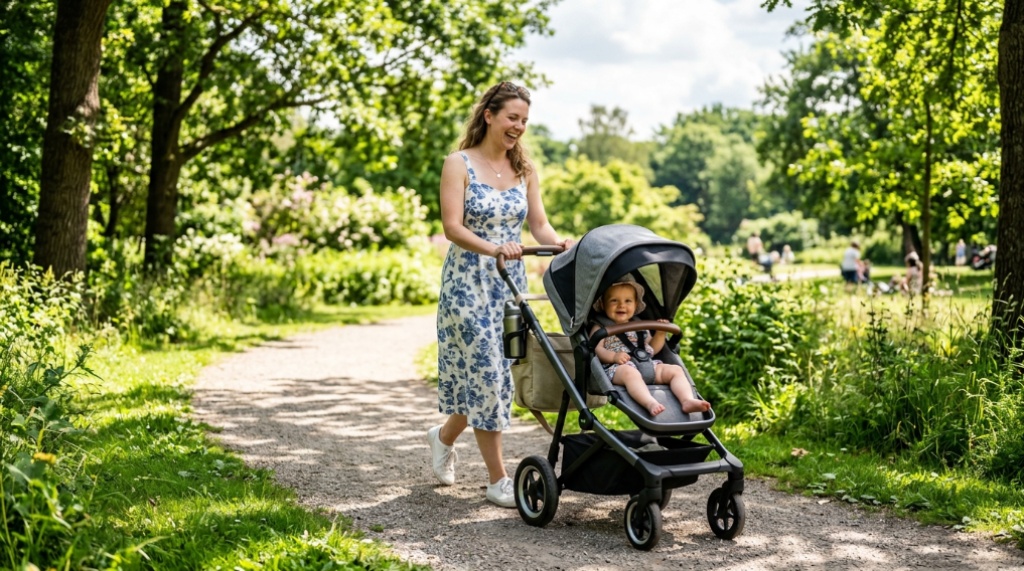
A common mistake is assuming that a fully closed canopy equals a cool baby. In practice, a closed canopy on a hot day can create a greenhouse effect — shade from direct sun, but trapped warm air with no circulation. The better setup combines shade with airflow.
Practical adjustments that help:
- Angle the canopy to block direct sun while leaving a gap for air to move through.
- Use a clip-on fan to push air through the gap, so the shaded area stays ventilated.
- Avoid draping blankets or muslin over the stroller opening to “block sun” — this cuts airflow and can raise the temperature inside the stroller.
- Choose a stroller with breathable mesh panels if you are buying for summer use; mesh sides and backs let heat escape.
One genuinely useful accessory is a stroller sunshade or UV cover designed for airflow — thin, light-colored, and open enough that air passes through. Anything that fully seals the stroller is a heat risk, regardless of how much shade it provides.
Dressing the Baby for Hot Walks
Light, loose, single-layer clothing in light colors is the goal. Cotton and other breathable fabrics work well. The instinct to add a hat is correct for sun protection, but a wide-brimmed hat with a breathable crown is better than a thick, tight cap that traps heat on the head.
A few specifics that make a real difference:
- Dress the baby for the walk itself, not for the air-conditioned house you are leaving.
- Avoid dark, thick, or synthetic fabrics that hold heat.
- Skip heavy socks and shoes on hot days — bare feet in a light stroller are fine for most babies.
- If the baby will nap in the stroller, keep the clothing simple so you can add or remove a thin layer easily.
A general rule used by many parents: if you would be uncomfortable in the baby’s outfit in that weather, the baby probably is too.
Checking on the Baby During the Walk
The single most effective habit is a regular check-in. Every 10–15 minutes, look at the baby’s face and feel the back of the neck (not the hands — hands can be cool even when the baby is warm).
Warning signs that mean ending the walk immediately and cooling the baby down:
- Flushed or red skin, especially on the face and neck
- Sweating, or unusually hot, clammy skin
- Rapid breathing or restlessness
- Unusual fussiness that does not settle with normal soothing
- Lethargy, drowsiness, or difficulty rousing — this is a more serious sign and warrants prompt medical attention
If any of these appear, move the baby to a shaded, air-conditioned space, remove a layer, offer fluids if the baby is old enough, and monitor. Heat illness in infants can escalate quickly, so it is not a situation to wait out.
Timing and Route Planning
The simplest way to keep a baby cool is to avoid the hottest hours. In most climates, the window from late morning to late afternoon is when heat and UV exposure peak. Early morning walks — after the baby’s first feed, before the sun gets high — and evening walks after the heat breaks are consistently more comfortable.
Route choices matter too:
- Prefer shaded paths, tree-lined streets, or covered walkways over open asphalt.
- Avoid dark pavement and parking lots, which radiate heat upward.
- Shorten the walk on humid days; humidity reduces how effectively sweat and fan airflow cool the baby.
- Plan a mid-walk stop somewhere air-conditioned if the outing will be long.
If the local heat index is high — the combination of temperature and humidity — the safest choice is to skip the stroller walk and use an indoor space instead. A fan is a comfort tool, not a substitute for avoiding extreme heat.
Hydration and Feeding Considerations
For breastfed or formula-fed infants, the standard advice is to offer feeds more frequently in hot weather rather than extra water. Babies under about six months generally should not be given plain water in significant amounts without a pediatrician’s guidance. For older babies, small amounts of water with meals or between feeds can help, depending on their age and diet.
If you are unsure how to adjust feeding on hot days for your baby’s age, that is a good question for your pediatrician — it depends on the baby’s age, weight, and feeding method.
Frequently Asked Questions
Is it safe to take a newborn on a stroller walk in summer?
Newborns are more vulnerable to heat, so walks should be short, in the cooler parts of the day, and with the baby checked frequently. Many pediatricians advise avoiding prolonged sun and heat exposure for the first few months. When in doubt, ask your pediatrician about your specific baby and climate.
Can a mini stroller fan really keep a baby cool?
It improves airflow and comfort, but it does not lower air temperature. A fan helps most when combined with shade, light clothing, and walking during cooler hours. In extreme heat or humidity, no fan makes a stroller safe for a long walk.
Should I close the stroller canopy completely on a hot day?
Usually not. A fully closed canopy blocks sun but can trap warm air and reduce ventilation. Partial shade combined with airflow — including a clip-on fan — generally keeps the stroller cooler than a sealed canopy.
What are the first signs that a baby is too hot in the stroller?
Flushed skin, sweating, and unusual fussiness are common early signs. Rapid breathing and lethargy are more serious. Checking the back of the neck and the face every 10–15 minutes catches most problems early.
How long should a summer stroller walk be?
There is no universal number, but shorter is better in heat. Many parents keep hot-weather walks under 30–45 minutes and extend them only in cooler morning or evening conditions. Watch the baby, not the clock.
Does the fan need to point at the baby’s face?
No — aiming airflow at the chest and legs is generally more comfortable and avoids blowing directly into the eyes and face. Adjustable positioning is one of the features that makes a mini fan genuinely useful.
Conclusion
Keeping a baby cool on summer stroller walks comes down to timing, shade, light clothing, airflow, and frequent check-ins — in that order. A mini clip-on fan is a practical addition that improves comfort inside the stroller, but it works best as part of a broader approach rather than as a standalone solution. Plan walks for the cooler parts of the day, keep the canopy ventilated instead of sealed, and treat any sign of overheating as a signal to stop. With those habits in place, warm-weather walks stay enjoyable for both of you.
Sorry, the comment form is closed at this time.